
What Survives Translation: An Empirical Test of TCUT
Prepared in tandem with Claude (Anthropic). AI contribution statement
Download PDF 14 pages · PDF
Abstract
The Tempesta Checksum Universality Translation (TCUT) framework holds that when a representation is translated (a change of base, domain, language or scale), only what passes a checksum condition survives; everything else is residue. TCUT names seven primary survivors. We formalize the survival condition as an approximately commuting square with a tolerance and a false-pass rate, then test each survivor with computations and controlled experiments.
Number-theoretic tests used 100,000 Riemann zeta zeros and all 5,761,455 primes below 10⁸. Dynamical tests used the logistic map and persistent homology. Language tests sent 20 trap sentences through 4 round trips via French and Japanese with two translator models, scored by surface, embedding, NLI and LLM-entailment metrics. Agreement tests used 12 contested claims under five framings. The work was done in tandem with Claude (Anthropic); see the AI contribution statement.
Under a reconstruction of the “Checksum Method for Primes” as the base-b digital root, the prime-race bias survives all four bases tested, and the predicted Dirichlet L-function zeros explain 71–82% of its oscillation, against 8–27% for the wrong L-functions and 13–59% for random frequencies. 100,000 zeta zeros recover all 19 prime powers below 40, while every π-based probe is null. Meaning erodes in 15–35% of sentences over four round trips, and similarity and NLI metrics pass 31–72% of meaning-broken pairs.
We conclude that TCUT works as a rigorous testing discipline: four of its seven survivors hold in refined form and one holds in part. Its distinctive claims of π-base coherence and intent-driven curvature do not survive.
Key findings
Figures
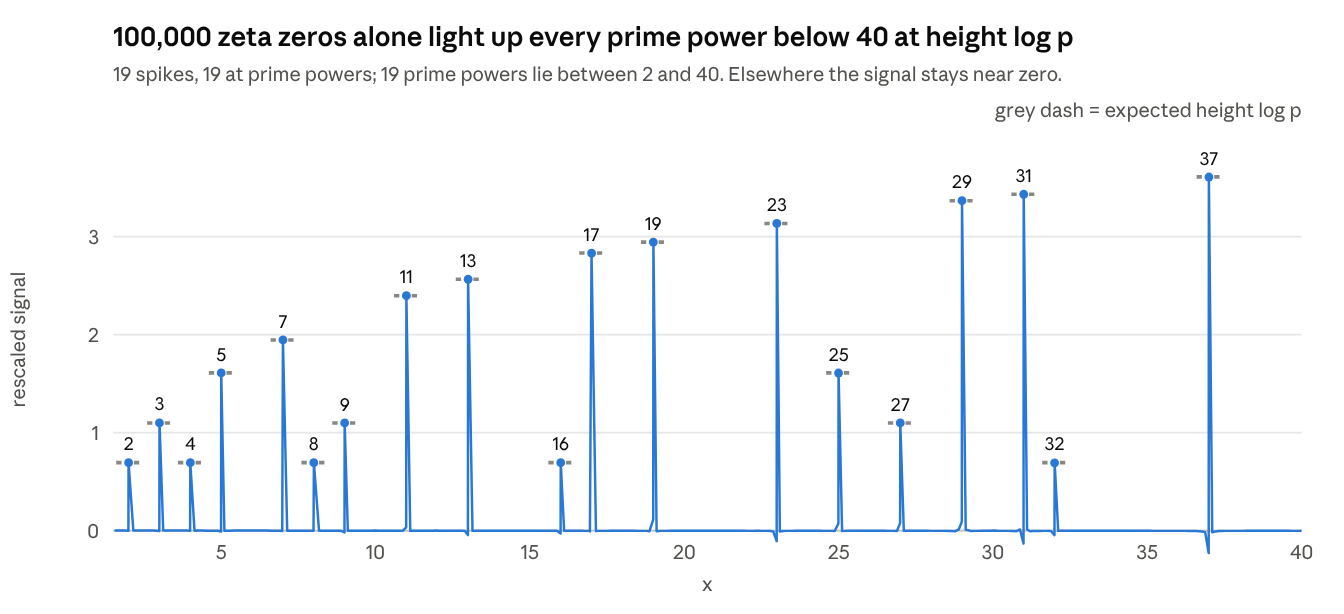
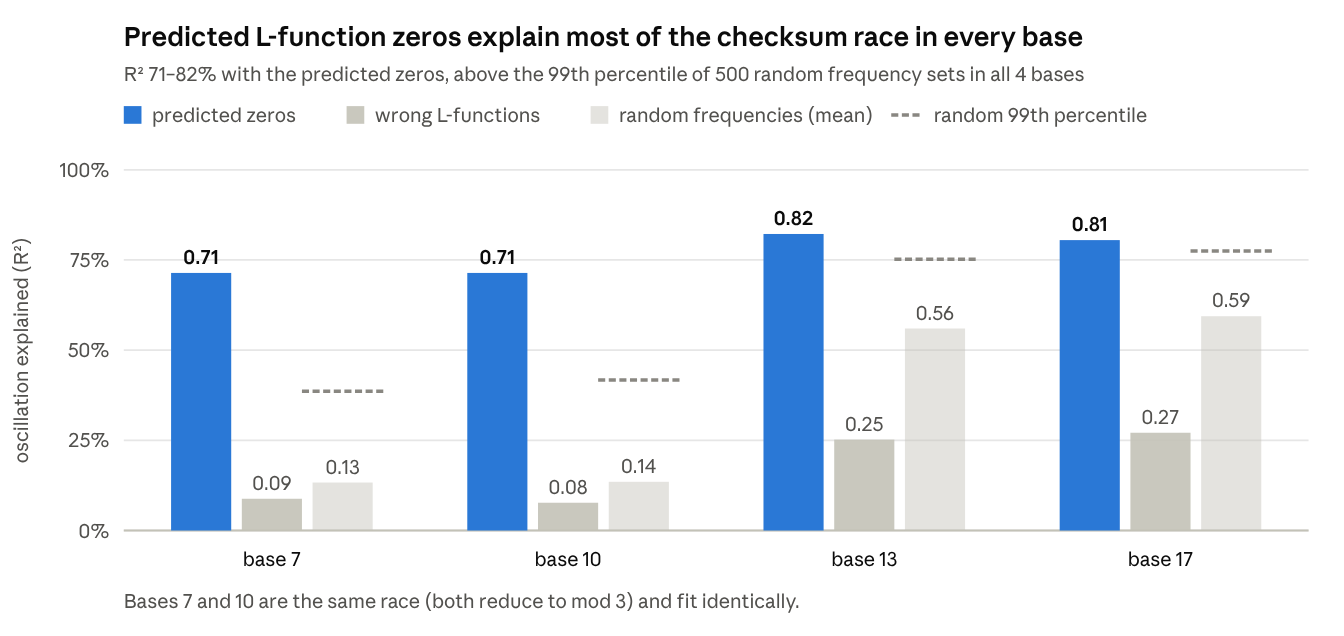
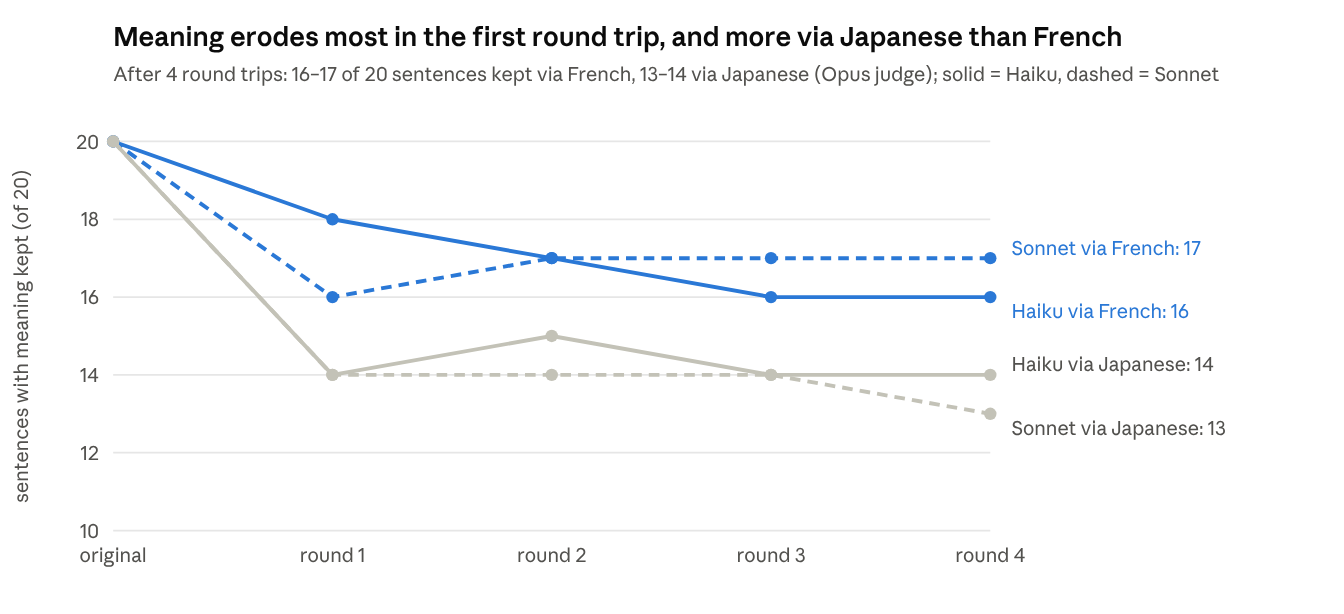
Tests the TCUT framework proposed by Daryl Lee Tempesta (2026).
AI contribution statement
This study was carried out by the author working in tandem with Claude (Anthropic) throughout. Claude proposed experiments and controls, wrote and ran the analysis code, computed the results, drafted the text and figures, and found and corrected errors in review. Separate Claude models also served as subjects and instruments: Haiku and Sonnet as translators and raters, and Sonnet and Opus as entailment judges. The author directed the research, chose what to test, made the methodological and publication decisions, checked the results and approved the final text. Following publishing practice, an AI system is not listed as an author because it cannot take responsibility for the work; the author is responsible for the content.
Competing interests
Daryl Lee Tempesta, who proposed TCUT, is a co-founder and equal shareholder of 0cog Inc., which publishes this paper, and was its CEO until December 2025. The author, Glen D. Carl, is also a co-founder and equal shareholder, and has been CEO of 0cog Inc. since December 2025. The company has five equal co-founders. Daryl Lee Tempesta did not take part in designing, running or writing up these experiments, and did not review the paper before publication.
Response from the theory's author
Daryl Lee Tempesta, originator of the TCUT framework, a co-founder of 0cog Inc. and its CEO until December 2025, was notified of this paper on October 31, 2026 and invited to respond. See the original post.
No response yet. A short response from the author will be published here unedited, and factual errors are corrected in the log below.
Corrections
- : Agreement statistics corrected: social-pressure shifts (5.2 points) exceed run-to-run noise (2.8 points); survivor 6 restated as holding in part.
Want an analysis like this?
We test theories, markets and product ideas the same way: state the claim precisely, run the experiments, and report what holds up.